


If you are looking into One Peak Creative's Amazon Affiliate Academy, you are probably trying to answer one simple question: is this actually worth it, or is it just another online course with good marketing?
That is the lens I am using here. I am not interested in pretending every creator course is life changing, and I am not interested in dismissing something just because it is a course. I care less about hype and more about whether the idea is useful for a real person with a busy life, limited time, and a realistic need for structure.
This one caught my attention because I already had an Amazon affiliate account and a storefront before really digging into the course. I made a few videos testing the idea myself, and honestly, I did not get very far with it.
That is part of why the Amazon Affiliate Academy is interesting to me. It is not that I needed someone to tell me Amazon affiliate links exist. I needed a better system for choosing products, creating content, and actually knowing what to do next.
That also fits with the bigger One Peak conversation on this site. I have already covered the larger One Peak Creative course lineup, looked at The TikTok and Reels Creator Course, and talked about whether busy adults can realistically keep content creation going alongside real life in this content creation and family life post.
The Amazon Affiliate Academy belongs in that same world because it is not just about links. It is about content, consistency, and knowing how to turn attention into something more practical.
If you are short on time, here is my honest take: the Amazon Affiliate Academy makes the most sense for beginners or busy creators who already like the idea of Amazon affiliate marketing but feel stuck on how to actually do it.
The value is not that Amazon affiliate marketing is impossible to learn without a course. You can find a lot of free information online. The value is structure. A clear course can save you from bouncing between random videos, half finished ideas, and scattered advice that does not turn into a real workflow.
I would not buy this expecting passive income in a few weeks. I would consider it if you want a step by step system for product selection, short form content, posting rhythm, and how to think about Amazon affiliate income in a way that is more organized than guessing.
My simple verdict: this looks best for beginners who are willing to post consistently and want help turning Amazon affiliate marketing into a repeatable content process. It is probably not a good fit for someone looking for a shortcut or someone who does not want to create content.
The Amazon Affiliate Academy is a One Peak Creative course focused on helping people understand and use Amazon affiliate marketing. Based on the public course positioning and the promotional material, the course appears to teach creators how to choose products, create short form content around those products, and use Amazon affiliate links or an Amazon storefront as the monetization path.
The reason this matters in 2026 is that Amazon affiliate marketing has changed for a lot of creators. It is not only about putting links in blog posts anymore. Blogs can still work, but many beginners are getting their first traction through TikTok, Instagram Reels, YouTube Shorts, and product focused social content.
That shift makes the course more interesting to me because it connects Amazon affiliate marketing with content strategy. The hard part for most beginners is not creating an Amazon account. The hard part is knowing what to post, what products to focus on, how to talk about those products without sounding fake, and how to stay consistent after the first burst of motivation fades.
A lot of free Amazon affiliate advice is technically true but not very useful. Someone will tell you to post links, create content, pick good products, and stay consistent. That sounds fine, but it still leaves a beginner asking, "Okay, but what does that actually look like this week?"
A course can be useful when it turns a vague idea into a checklist. I would want to see clear lessons on product research, content examples, hook writing, storefront setup, posting frequency, testing, and what to do when the first few videos do not work. That is the kind of structure that can help a beginner move from interest to execution.
Based on the public course page and the way the offer is positioned, the Amazon Affiliate Academy appears to be built around a practical creator system. I would break that system into four main parts: understanding the Amazon affiliate setup, choosing products with real demand, creating short form content, and repeating the process until you start seeing useful data.
That order matters. A lot of beginners jump straight into posting without thinking about product fit. Others spend all their time researching and never publish. A good affiliate system needs both sides. You need smart product selection and enough content volume to find what works.
Product selection is one of the biggest differences between random affiliate content and content that has a real chance. If you pick products nobody wants, or products that are hard to explain in a short video, you are making the job harder than it needs to be.
The best beginner products are usually easy to understand, visually clear, and connected to a specific problem. A home organization product, desk accessory, kitchen tool, travel item, or simple beauty product can often be explained in seconds. That matters because people are scrolling fast.
The course also appears to connect Amazon affiliate marketing with short form video. That is important because the content is often the real bottleneck. You can have the best link setup in the world, but if nobody sees or trusts your content, the link will not do much.
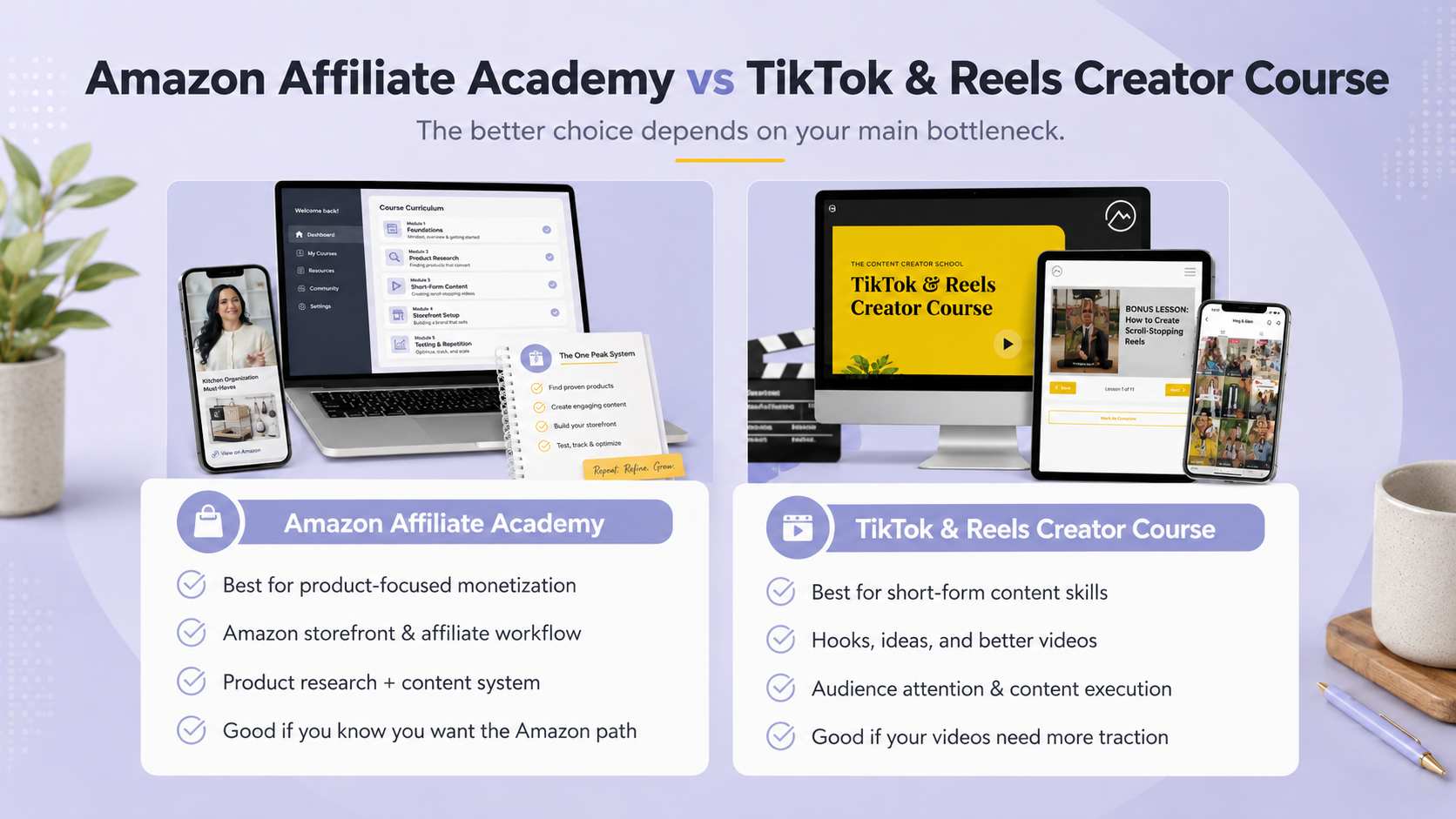
This is why I would naturally compare the Amazon Affiliate Academy with The TikTok and Reels Creator Course. One course seems focused on the monetization path through Amazon, while the TikTok and Reels course is more about learning the content engine itself. If your real problem is that your videos do not get attention, that content skill may matter just as much as the affiliate strategy.
The other piece I would look for is repetition. Affiliate content rarely works because one video magically solves everything. It works because you test hooks, formats, products, and angles over time. A good course should help you understand that process before you get discouraged by the first few posts.
This is probably a good fit if you are a beginner who likes the idea of Amazon affiliate marketing but keeps getting stuck at the execution stage. Maybe you have an account. Maybe you have a storefront. Maybe you have even posted a few videos. But if you do not know what to do next, that is where structure can help.
It also makes sense for busy adults, parents, or working creators who do not have endless hours to experiment. If your content time is limited, guessing gets expensive. Not always financially expensive, but time expensive. A course can be valuable if it reduces wasted effort and helps you focus on the parts that actually matter.
That is the same reason I like looking at creator courses through a busy adult lens. A strategy can sound amazing until you try to fit it into real life. If you are balancing work, family, and content, the approach has to be repeatable. I have talked about that bigger reality in how content creation fits into family life and how modern dads can make money from home.
The best fit is someone who is willing to create content consistently but needs direction. If you can commit to filming product focused videos, testing hooks, learning from the data, and improving over time, a structured course can support that.
It is also a fit for creators who want to turn everyday product knowledge into content. If people already ask you about things you use at home, parenting products, organization tools, beauty items, tech accessories, or Amazon finds, this model may feel natural.
I would probably skip this if you are looking for fast passive income. Amazon affiliate marketing can become more efficient over time, but the beginning is not passive. The beginning is research, filming, posting, testing, and adjusting.
I would also skip it if you do not want to create short form content. The course seems built around a creator led approach, which means you need to be comfortable putting content into the world. You do not have to be perfect on camera, but you do need to be willing to publish consistently.
Finally, I would skip it if you are hoping a course will remove the uncomfortable part. No course can post for you, make the algorithm care, or guarantee people buy through your links. The course can give you a system. You still have to run the system.
The biggest red flag is expecting the course to replace effort. If you buy it and only watch the lessons, nothing changes. A course only becomes useful when it changes your behavior. You need to apply the lessons, post more intentionally, and review what is working.
The biggest thing I like is that the course appears to connect a real monetization model with a content system. That matters because too many beginners separate the two. They either create content with no monetization plan, or they set up affiliate links with no attention strategy.
Amazon affiliate marketing sits in the middle. You need content that gets attention, but you also need a clear path from attention to action. A viewer has to understand the product, trust the recommendation enough to click, and feel like the product solves a real problem.
I also like that the One Peak style usually feels more practical than flashy. I am a pretty big One Peak fan because their courses tend to feel built with effort, not just thrown together. That does not mean every course is perfect for every person, but it does make me more willing to take a closer look.
If you are new to One Peak in general, I would start with the broader One Peak Creative courses review so you understand how this course fits next to their other creator focused products.
The main thing I would be careful about is income expectations. Course pages often use strong success stories because those stories are exciting. That is normal marketing. But as a buyer, I would not use someone else's result as my personal expectation.
If the course page says a creator earned a major amount through Amazon affiliates, I would treat that as proof that the model can work for some people, not proof that it will work the same way for everyone. Your niche, posting volume, product choices, platform, timing, and consistency all matter.
I would also verify the current course details before buying. Course pricing, modules, bonuses, guarantees, and refund terms can change. I would never make a purchase based only on a review like this. I would read the current course page and make sure the format fits how you learn.
This is where the One Peak ecosystem gets interesting. The Amazon Affiliate Academy appears to be more about the affiliate income path. The TikTok and Reels Creator Course is more about learning how to make short form content that can actually get attention.
Those skills overlap, but they are not identical. You can understand Amazon affiliate marketing and still struggle to make videos people watch. You can also understand TikTok and Reels and still have no clear monetization strategy. The strongest setup is when both pieces work together.
If your biggest issue is learning how to create better short form videos, I would compare this with The TikTok and Reels Creator Course from One Peak Creative. If your biggest issue is learning how to turn product content into Amazon affiliate income, the Amazon Affiliate Academy is the more direct fit.
I would also read my breakdown of whether you really need a TikTok course to grow because that question applies here too. A course is useful when it gives you structure you will actually use. It is not useful if you only buy it because you are frustrated.
The reason this course feels relevant to me is that I have already been close to this model without really building the system. Having an Amazon affiliate account and storefront is one thing. Knowing how to create repeatable product content is another thing.
I made a few videos testing the idea, and I did not get much traction. That does not mean the model does not work. It probably means I did not have the right system yet. I was testing without enough structure, and that is exactly the problem a course like this is supposed to solve.
That is also why I am more excited about the course than I would be if it were just a random affiliate marketing program from a random person. One Peak already has a creator education lane. They understand short form content, creator psychology, and the practical side of getting people to post. That makes the Amazon angle feel like a natural expansion.
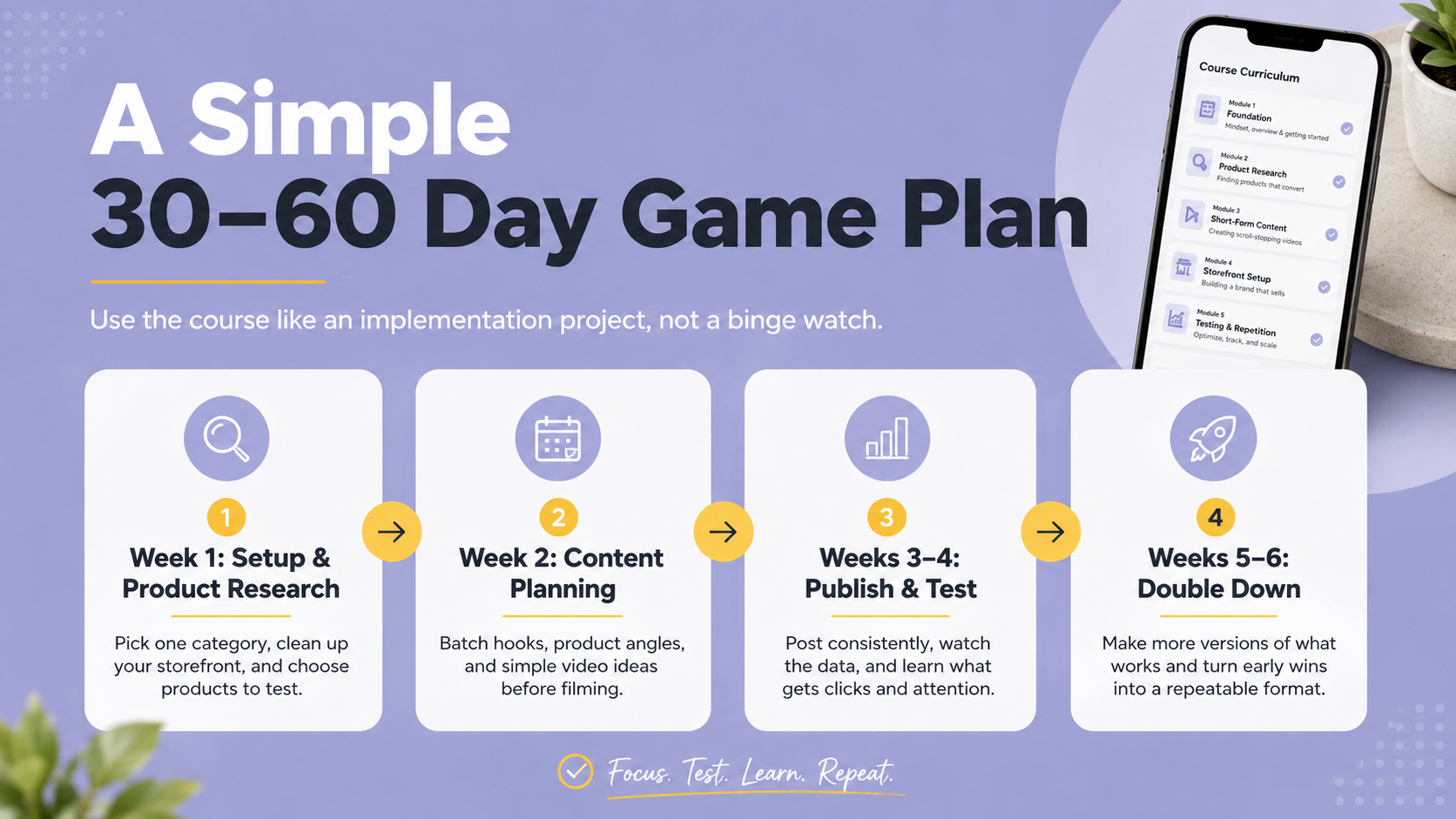
If I were taking the Amazon Affiliate Academy, I would not treat it like something to binge watch and forget. I would turn it into a 30 to 60 day implementation project. That is the only way a course like this becomes useful.
I would start by cleaning up the storefront, understanding the rules, and choosing one product category to focus on. I would not try to promote everything. I would pick a lane and make the first test manageable.
Then I would write a batch of simple video ideas. I would focus on hooks, product demonstrations, problem solving angles, and content that feels helpful instead of salesy. The goal would be to make posting easier before filming starts.
After that, I would publish consistently and pay close attention to the data. Which products get questions? Which hooks hold attention? Which videos get clicks? Which ones get ignored? That feedback is the real teacher.
Once something works, I would not abandon it. I would make more versions. I would test the same product with a different hook, compare it to another product, answer common questions, and try to turn one signal into a repeatable format.
My honest take: the One Peak Creative Amazon Affiliate Academy looks most useful for beginners and busy creators who want a structured path into Amazon affiliate marketing through short form content.
I do not think it is for everyone. If you hate making content, want guaranteed income, or expect results without consistent effort, I would skip it. If you already know you want to try Amazon affiliate marketing but keep getting stuck on what to post and how to approach it, this could be a helpful next step.
The biggest value is not magic. It is organization. A good course gives you fewer excuses, a clearer workflow, and a better way to test. That does not guarantee results, but it can make the process less random.
For me, the course is interesting because I have already tried the Amazon affiliate idea in a small way and did not get anywhere meaningful. That makes me more open to learning the system properly instead of guessing. And because it is coming from One Peak, a team I already trust more than most creator course brands, I would take it seriously.
If you want to look at the content side first, check out The TikTok and Reels Creator Course from One Peak Creative. If you want the broader context before deciding, start with my One Peak Creative courses review and compare which course matches your actual problem.
Is the One Peak Creative Amazon Affiliate Academy worth it?
It can be worth it if you are a beginner who wants structure and you are willing to create content consistently. It is probably not worth it if you expect passive income or guaranteed results.
Is this course only for people with a big audience?
No. The whole appeal of short form content is that beginners can sometimes reach people without a large following. A big audience helps, but it is not the only path.
Can I learn Amazon affiliate marketing for free?
Yes, you can learn a lot for free. The tradeoff is that free information is often scattered. A course may help if you want a clearer path and less guessing.
Do I need TikTok or Instagram to make Amazon affiliate marketing work?
Not always, but short form platforms are one of the most practical ways for beginners to get product content in front of people. Blogs, Pinterest, YouTube, and email can also work depending on your strategy.
Should I take the Amazon Affiliate Academy or the TikTok and Reels Creator Course?
If your main issue is monetizing through Amazon, the Amazon Affiliate Academy is more directly related. If your main issue is making better short form videos, the TikTok and Reels Creator Course may be the better starting point.
Disclosure: I may receive affiliate compensation for some of the links below at no cost to you if you decide to purchase a paid plan. You can read our affiliate disclosure in our privacy policy. This site is not intending to provide financial advice. This is for entertainment only.


