

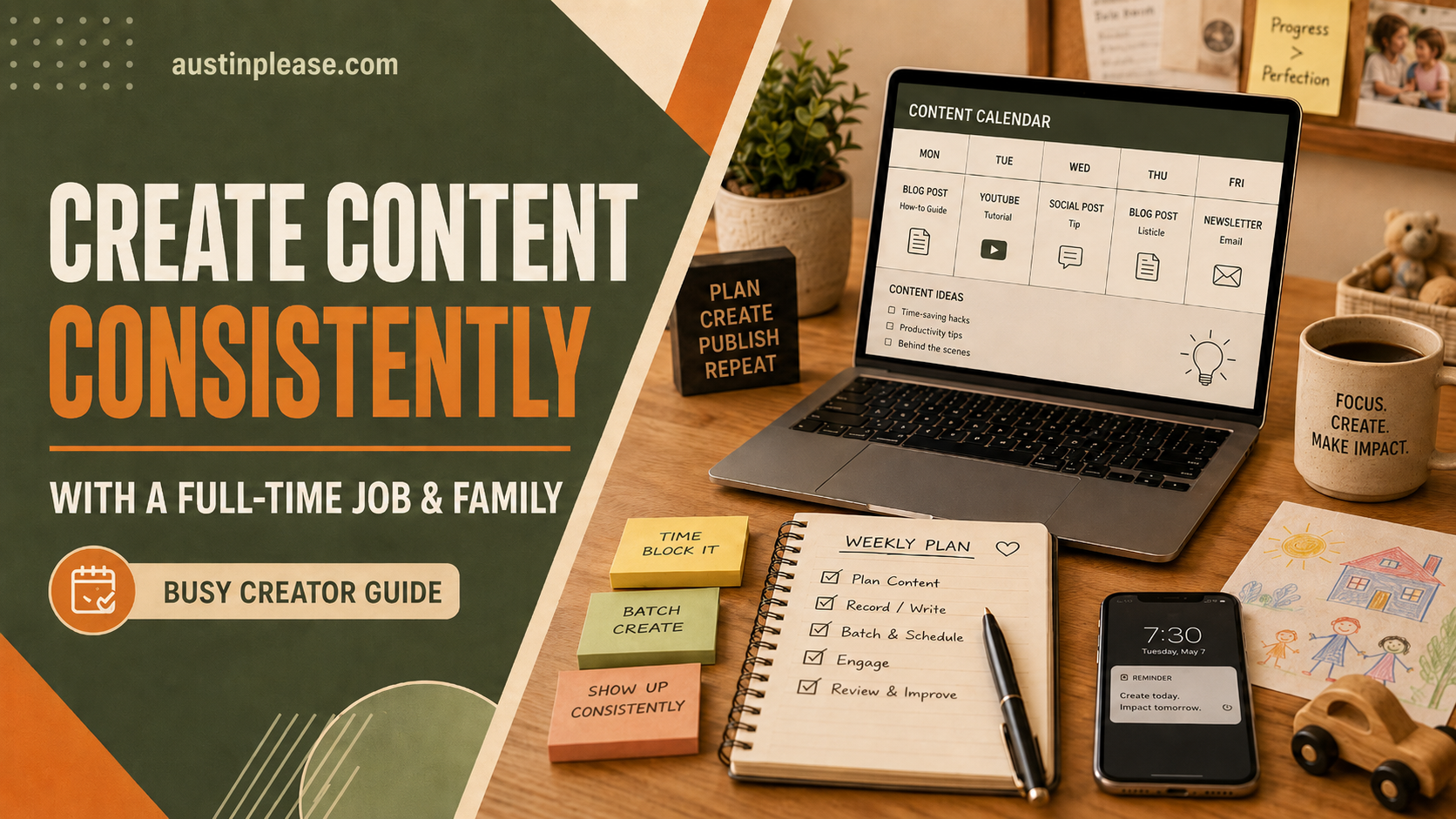
If you’re trying to create content consistently with a full-time job and family, I’ll be honest: the problem usually isn’t motivation.
It’s the schedule.
You can have good ideas. You can understand that posting matters. You can even feel excited about building something online.
But then real life shows up.
Work gets busy. The kids need something. Dinner has to happen. Someone gets sick. You sit down at 9:30 p.m. to “finally create,” and your brain feels like a browser with 47 tabs open.
So when people say, “Just be consistent,” I think that advice is technically true but not very helpful.
The real question is: how do you stay consistent when your life is already full?
That’s what I want to break down here. Not a perfect creator routine. Not a “wake up at 4 a.m. and dominate your day” fantasy. Just a practical content system for busy adults, parents, and people working full-time who still want to build something on the side.
If you want to create content consistently with a full-time job and family, you need three things:
That’s it.
You don’t need to post every day. You don’t need to be on every platform. You don’t need to turn your life into a content machine.
You need a system that still works when you’re tired.
That’s the part most people miss.
This is where I think a lot of busy people get stuck.
They look at full-time creators and try to copy their schedule. Daily videos. Multiple platforms. Constant posting. Long-form content. Short-form clips. Email newsletters. Live streams. Threads. Carousels.
That might work if content is your main job.
But if you’re working a 9–5, raising kids, managing a household, or trying to have any kind of normal life, that kind of schedule can burn you out fast.
You do not need a full-time creator’s workload.
You need a part-time creator’s system.
That might mean one strong blog post per week. Or one YouTube video every two weeks. Or three short posts per week on one platform.
The goal is not to do the most. The goal is to do something you can actually repeat.
Consistency beats intensity almost every time.
One reason content feels overwhelming is that people keep asking, “What should I post today?”
That question gets exhausting fast.
Instead, pick two or three content pillars you can come back to every week.
If you’re building around content creation as a busy parent or working adult, your pillars might be:
That gives you a lane.
Now you’re not waking up every day trying to invent your entire strategy from scratch. You’re just choosing a topic inside a lane you already understand.
Here’s what that might look like:
Nothing fancy. Just repeatable.
That’s the part that matters.
I don’t think most creators should brainstorm every day.
That sounds small, but it makes a big difference.
When you brainstorm every day, you’re forcing your brain to restart the whole process over and over. That’s how you end up staring at a blank screen, checking your phone, and calling it “research.”
Instead, set aside one short block each week to come up with ideas.
Even 20 minutes can work.
Open a doc and write down 10 to 15 ideas. They do not have to be perfect. They just need to exist.
A few prompts that help:
Now you have a small idea bank.
That means when it’s time to create, you’re not starting cold. You’re choosing from a list.
That alone can save a lot of mental energy.
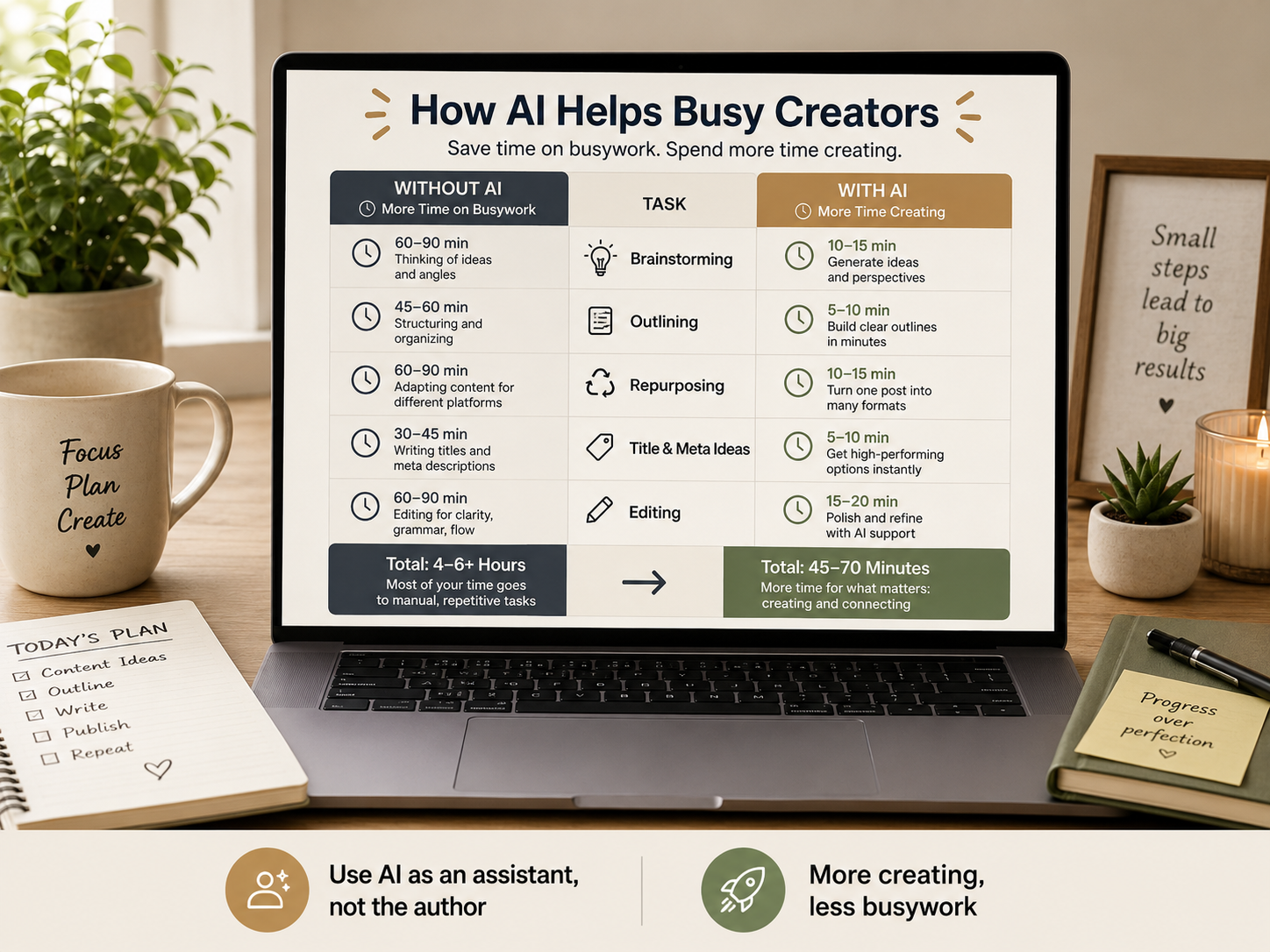
This is where AI can be genuinely useful.
I don’t think the best use of AI is copying a full article or caption and posting it as-is. That’s usually how content starts sounding generic.
The better use is structure.
You can use AI to turn a messy idea into:
Then you bring in your real opinion, experience, and voice.
That’s the difference.
AI helps you move faster, but you still make the content feel human.
Instead of asking AI, “Write me a post about creating content,” you could ask:
“Give me a simple outline for a blog post about how busy parents can create content consistently with only 3 to 5 hours per week. Keep it practical, honest, and not hypey.”
That gives you a starting point.
Then you edit it, add your perspective, and make sure it sounds like something you’d actually say.
That workflow is much better than trying to force yourself to build every piece from scratch.
And this is also where something structured like the AI Creator Course can be helpful, especially if you don’t want to keep piecing together random tips. The value is not just “more AI information.” It’s having a repeatable way to use AI for content without turning your process into a mess.
A lot of busy people wait for a big open block of time.
That sounds logical, but it can backfire.
Because sometimes that big open block never comes.
Instead of waiting for three perfect hours, build a workflow that works in 30-minute pockets.
Here’s a simple version:
Session 1: Brainstorm ideas
Spend 20 to 30 minutes creating a list of topics.
Session 2: Outline one piece
Use AI or a simple template to outline the post, video, or email.
Session 3: Draft the content
Write messy. Do not edit while writing.
Session 4: Edit and publish
Clean it up, add the headline, write the description, and schedule it.
That might not sound exciting, but it works.
And when you’re busy, boring systems are usually better than exciting plans.
The point is to stop depending on perfect conditions.
You’re building a process that can survive real life.
This is one of the biggest time-savers.
You do not need to create every piece of content from scratch.
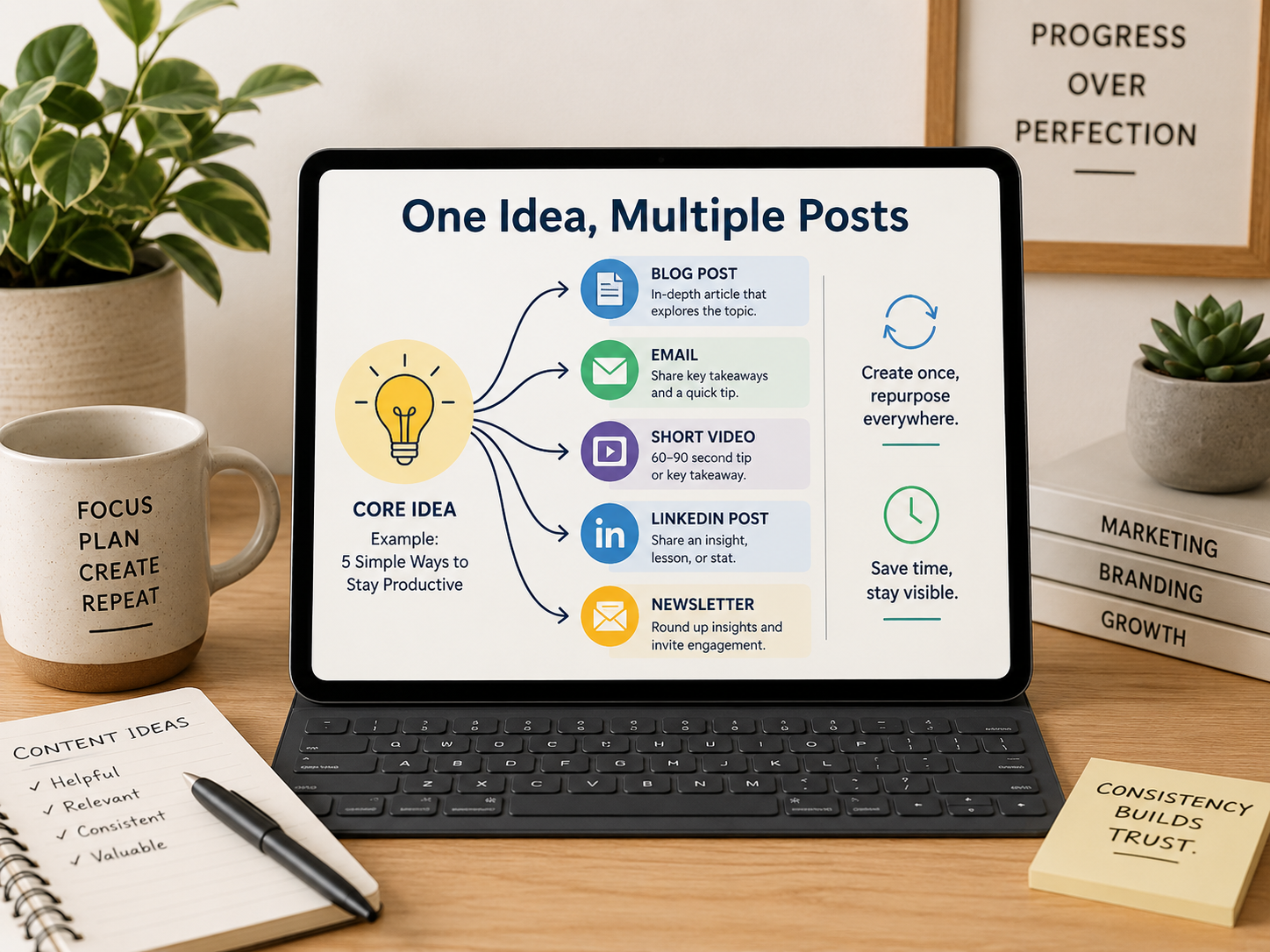
Take one strong idea and turn it into several smaller pieces.
For example, one blog post can become:
That does not mean you copy and paste the same thing everywhere. Each platform needs a slightly different format.
But the core idea can stay the same.
That’s how you get more mileage from the work you already did.
A busy creator should not be trying to invent new ideas every day. That’s exhausting.
A better goal is to build a small content engine where one good idea turns into several useful pieces.
That’s how you stay visible without spending your whole life online.
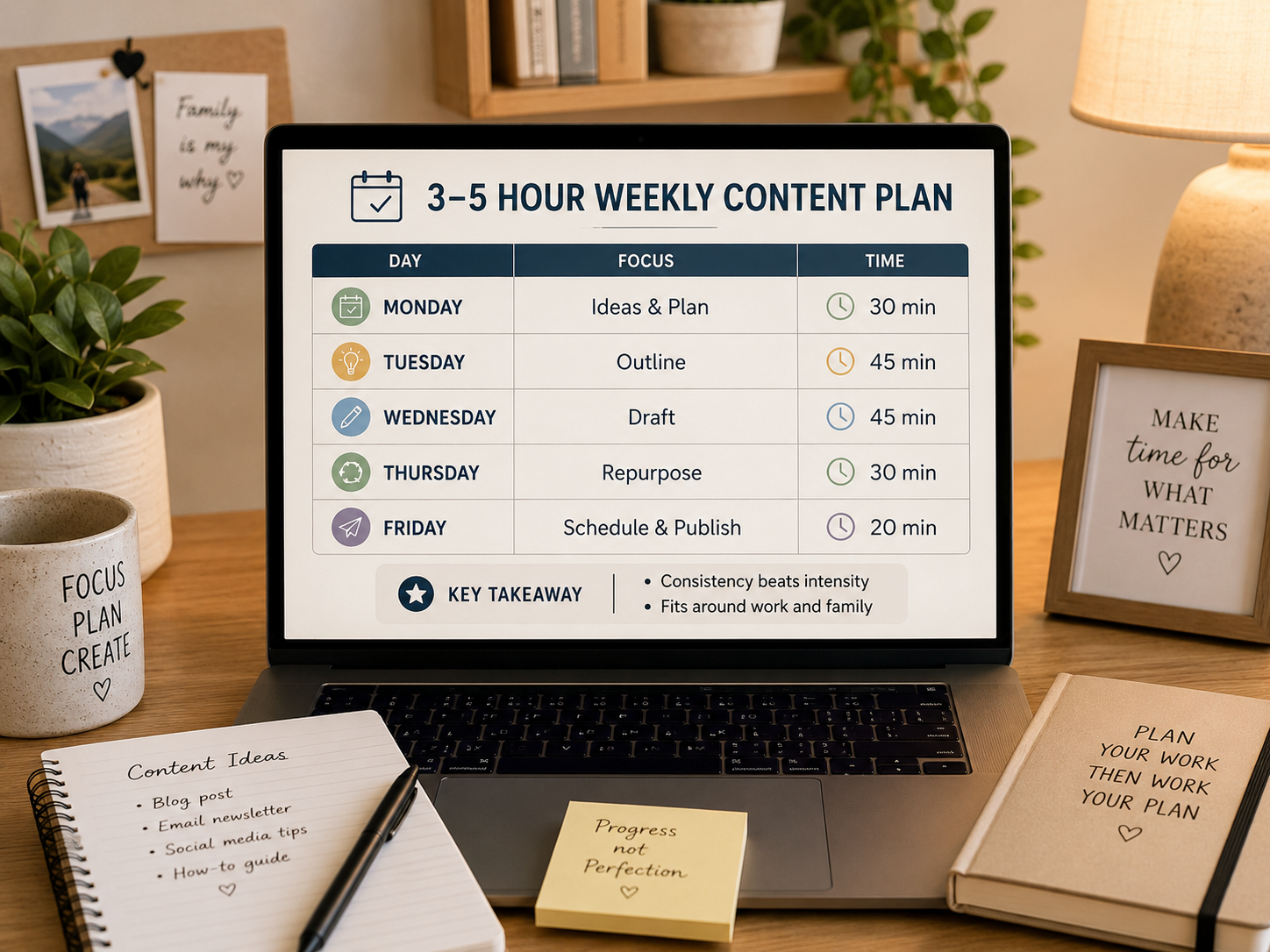
Here’s a realistic weekly schedule for someone with a full-time job and family.
Monday: 30 minutes
Brainstorm ideas and pick one main topic for the week.
Tuesday: 45 minutes
Create the outline and rough draft.
Wednesday: 30 minutes
Edit the draft and add personal examples.
Thursday: 30 minutes
Repurpose the idea into 2 or 3 smaller posts.
Friday: 20 minutes
Schedule or publish everything.
That’s about 2.5 to 3 hours.
You can expand it if you have more time, but the base system is small enough to stick with.
And that’s the key.
A content plan is only useful if it fits your actual life.
This might sound strange, but I think a lot of creators need to lower the bar.
Not lower the quality forever. Just lower the starting point.
If your plan requires perfect energy, perfect focus, and perfect timing, it probably won’t last.
Your minimum version should be easy enough that you can still do it during a busy week.
That might mean:
Whatever it is, make it realistic.
You can always do more later.
But first, prove to yourself that you can keep showing up.
That confidence matters.
Being consistent does not mean being everywhere all the time.
It means people can trust that you’ll keep showing up with useful ideas.
For some creators, that’s three posts per week.
For others, it’s one strong article every week.
For others, it’s a newsletter every Friday.
There is no universal rule.
The best schedule is the one you can repeat without resenting it.
And honestly, if you have a full-time job and family, your content system should protect your energy. Not drain it.
The whole point is to build something sustainable.
My honest take: creating content consistently with a full-time job and family is possible, but only if you stop treating content like a daily emergency.
You need a simple system.
Pick a few topics. Batch your ideas. Use AI for outlines and repurposing. Create in small time blocks. Reuse your best ideas. Keep the schedule realistic.
That’s how content starts feeling manageable.
Not easy. Not automatic. But manageable.
And that’s enough to build momentum.
If you’re tired of guessing every week and want a more structured way to use AI for content, the AI Creator Course is worth a closer look. I’d start by reviewing the course page and seeing if the workflow fits the way you want to create.
You do not need to become a full-time creator overnight.
You just need a system that helps you keep going.
For busy adults, parents, and people building on the side, that’s the real win.
Disclosure: I may receive affiliate compensation for some of the links below at no cost to you if you decide to purchase a paid plan. You can read our affiliate disclosure in our privacy policy. This site is not intending to provide financial advice. This is for entertainment only.


