

Hey busy parents, quick context before we go any further. I’ve grown on TikTok and Instagram Reels without buying a course, and I’m definitely not the only one. Plenty of creators do it that way.
The tradeoff is simple: pay with money for a course, or pay with time through trial, error, and uncertainty.
If you’re a busy parent, a 9–5 professional, or someone creating in small pockets of free time, that difference matters. You don’t have endless hours to experiment, restart, and figure things out the hard way.
In this guide, I’ll break down the real differences between DIY growth and paid training, so you can decide which tradeoff actually fits your life right now.
You don’t need a course to grow, get views, or build an audience.
What you do need is a consistent method. That’s where most people get stuck.
Many creators struggle on TikTok and Reels not because they lack a course, but because they post without a strategy or feedback, which makes progress feel random.
If you’re willing to publish regularly, pay attention to what happens, and make small improvements each week, DIY growth is absolutely possible. Even with just three to seven hours a week.
Growing without a course is a lot like building IKEA furniture with no manual. You might figure it out eventually, but you’ll probably waste time, get frustrated, and redo things you didn’t need to redo.
A course isn’t magic; it shortcuts the guessing phase.
Here’s how the tradeoff usually looks in real life.
The DIY path, which is time-heavy:
The course path is money-heavy:
More time than money? DIY works. Short on time? A course can help.
Posting more only helps if your content improves each time.
What you really need is a feedback loop.
Here’s what that looks like in real life:
That’s how you grow without a course. Not by watching fifty free videos and never shipping anything.
Many creators post for months and get stuck. It’s usually not laziness. It’s one of a few common problems.
First, there’s no clear niche. You talk about a little bit of everything, so the algorithm can’t place you, and viewers don’t really know why they should follow.
Second, the hooks are soft. If the first one or two seconds don’t stop the scroll, the rest of the video doesn’t get a chance.
Third, there’s no repetition. Every post feels like a brand-new experiment instead of part of a system that builds on what already works.
And finally, everything runs on motivation. That works for about a week. Then work, parenting, and exhaustion kick in, and posting fades out.
DIY growth punishes randomness. Those succeeding treat content as a process, not just an inspired task.
If you don’t want to buy a course, you still need a clear system. The following process works well for busy creators:
Here’s a breakdown of a practical DIY system for creators:
Step 1: Batch ideas, about 30 minutesSit down once and write out ten video ideas. Pull from real problems people are already searching for or asking about. Think about questions you’ve answered more than once or things you keep explaining to friends. Don’t overthink it. Messy ideas are fine.
Step 2: Batch scripts, about 60 minutesThis is where structure saves time. I use a simple flow called H.I.V.E.S.Hook is the first line that stops the scroll.Interest is why they should keep watching.Value is the actual point or lesson.Engagement is a quick prompt, like a question or takeaway.A summary is a short wrap-up that reinforces the message.
Once you get used to this flow, scripting gets fast. You’re not staring at a blank screen, wondering what to say.
Step 3: Batch filming, 60 to 90 minutesFilm five to ten videos in one session using the same setup. Don’t get stuck perfecting lighting or retaking shots; aim for good enough.
Step 4: Post and remix, about 15 minutes a dayPost consistently, then pay attention to what works. When something performs well, remix it. Same topic with a new hook, or same hook with a different example. You’re not starting from scratch every time.
Do this, and you end up with what I think of as an infinite content engine. You stop relying on inspiration and start building steady output. That’s how DIY growth actually becomes sustainable.
Most of the time, your content isn’t failing because your advice is bad. It fails because people don’t understand the point fast enough.
That’s where packaging comes in.
Packaging is the hook, the on-screen title text, who the video is clearly for, and the pacing and structure that keep things moving.
Two creators can share the exact same tip. One gets 200 views. The other gets 200,000. The difference is usually clarity, not talent.
If DIY is your path, make packaging a weekly practice. Don’t just post and hope it works.
You don’t always need to pay for a course. DIY can be more than enough if you’re in the right phase.
It usually makes sense to go DIY if you’re brand new and just need reps, you can commit to posting for at least 30 days, and you’re comfortable teaching yourself along the way. It also helps if you’re okay with slower growth over three to six months.
In that phase, I’d save the money. Focus on posting consistently, learning your niche, and building confidence. That foundation matters more than anything early on.
DIY isn’t hard because learning is impossible. It’s hard because you’re forced to make a thousand tiny decisions.
What do I post today? What hook should I use? Is my niche too broad? Should I follow trends? Do I need to start over?
Every decision drains a little energy. And if you’re a parent or a busy professional, that energy is already limited.
That’s why people quit. Not because they can’t do it, but because they don’t have a plan that survives interruptions.
A good course helps by removing those decisions. You open the checklist and execute.
Information is everywhere. The internet is full of tips. A good course isn’t just more content; it’s structure.
A good course gives you a step-by-step roadmap, hook and script templates, weekly goals that fit real schedules, clear examples to model, and a process to figure out what’s actually working.
A bad course does the opposite. It leans on vague mindset talk, piles on modules without a clear action plan, and teaches strategies that don’t fit real life. No templates. No feedback loop. Just more noise.
If you decide to pay, pay for clarity and implementation, not more information.
OnePeak is built for people who want growth but don’t want to stitch together a strategy from random videos all over the internet.
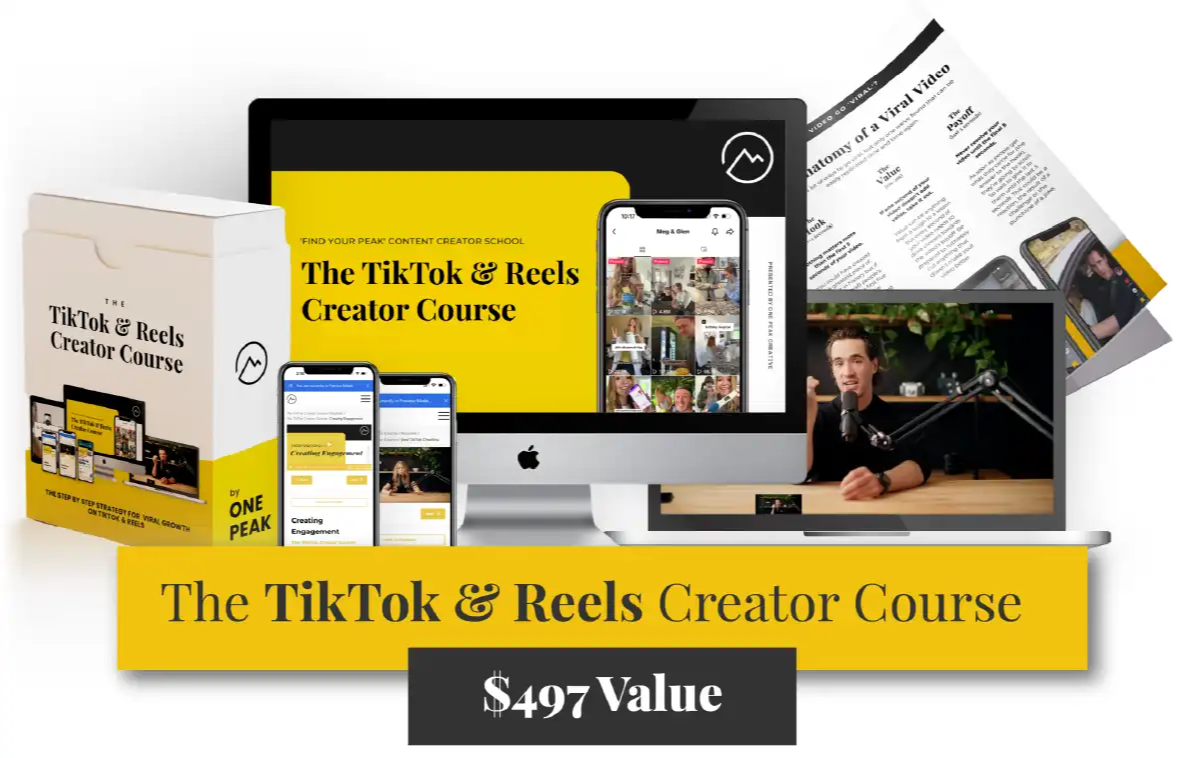
It’s a good fit if you’ve got limited weekly hours, somewhere in that three to seven hour range, and you want a clear plan with templates you can actually use. It helps if you’re looking for a repeatable posting system and you’re tired of hovering in the same view range, no matter how often you post.
If you’re already posting consistently but feel stuck, that’s usually the signal. You don’t need more content. You need better hooks, stronger formats, and smarter repetition. That’s the gap this kind of structure is meant to close.
Even if you can afford it, I wouldn’t buy a course if any of these are true.
If you haven’t posted at all yet, if you’re switching niches every week, if you’re looking for a guarantee, or if you don’t have the time to implement at least three posts a week, a course probably won’t help.
Courses amplify execution. They don’t replace it.
Here’s what the time breakdown looks like in real life.
Bare minimum, around three hours a week:
Ideal, closer to five to seven hours a week:
If you’re a parent, plan for micro-sessions. Fifteen minutes during nap time. Twenty minutes after bedtime. Voice notes during a commute.
It’s not about perfect routines. It’s about routines you can actually repeat.
Let’s say you work full-time and you’ve got kids. You can still run a simple weekly plan without blowing up your evenings.

Here’s what that can look like:
That’s under three hours total. The key is that every step feeds into the next, so you’re never starting from zero.
Repeat this for a month, and you’ll have real data, more confidence, and a clear direction on what to double down on next.
Short-form growth comes in waves. It’s not linear, and that’s important to understand going in.
Here’s a realistic timeline if you post consistently and actually improve week to week.
In the first 30 days, you’re mostly finding your voice. A few posts might spike, but most of them are learning reps. That’s normal.
Around 60 to 90 days, things start to settle. Your niche gets clearer, formats become repeatable, and views feel less random.
Between three and six months, follower growth becomes more consistent. Conversions improve. And content starts to feel easier, not forced.
Income is a separate conversation. It depends more on how you monetize than on raw view counts. A smaller audience can easily outperform a large one if you’re selling something specific and genuinely helpful.
So, can you grow on TikTok or Reels without a course? Yes, absolutely.
Where most people fail isn’t a lack of information. It’s that they never build a process they can repeat once life gets busy.
DIY works if you’re patient, consistent, and willing to track what’s working and adjust as you go. That takes time and discipline, but it’s doable.
A course like OnePeak’s TikTok + Reels Creator Course can make sense if you’re short on time and want a clear system, templates, and a weekly plan you can follow without burning out.
At the end of the day, the best option is the one that lets you repeat your process for 90 days straight. That’s the real path to growth and real results.
Disclosure: I may receive affiliate compensation for some of the links below at no cost to you if you decide to purchase a paid plan. You can read our affiliate disclosure in our privacy policy. This site is not intending to provide financial advice. This is for entertainment only.


