


If you’re balancing a full-time job and family, learning content creation can feel overwhelming. What you need is a clear plan, realistic time estimates, and a course designed for busy schedules.
That’s why this question keeps popping up: Is the AI Creator Course manageable and legit for busy professionals in 2026, producing real results without extra hassle?
So in this review, I’m going to walk through what the AI Creator Course actually covers, who it works best for, who should probably skip it, and what kind of results are realistic if you can only carve out three to seven hours a week.
No hype here. Just a straight, practical take so you can decide if this fits your schedule, your goals, and your bank account.
If you’re a busy professional seeking structure, the AI Creator Course is a smart investment in 2026. It offers a straightforward, time-saving process to help you avoid wasted effort and overthinking.
The course is most useful if you’re starting from scratch, offering guidance on choosing a niche, positioning your content, and using a repeatable workflow. Templates and prompts help ensure you keep posting, and the connection between content and sales is explained without being pushy.
It’s not for everyone. If you already have a content process or dislike structured programs, much of this will feel familiar, and it won’t change old habits.
The truth is, most creators don’t fail because of a lack of talent, but because of a lack of process. This course only matters if you’ll actually follow it, even when life is busy or motivation is low.
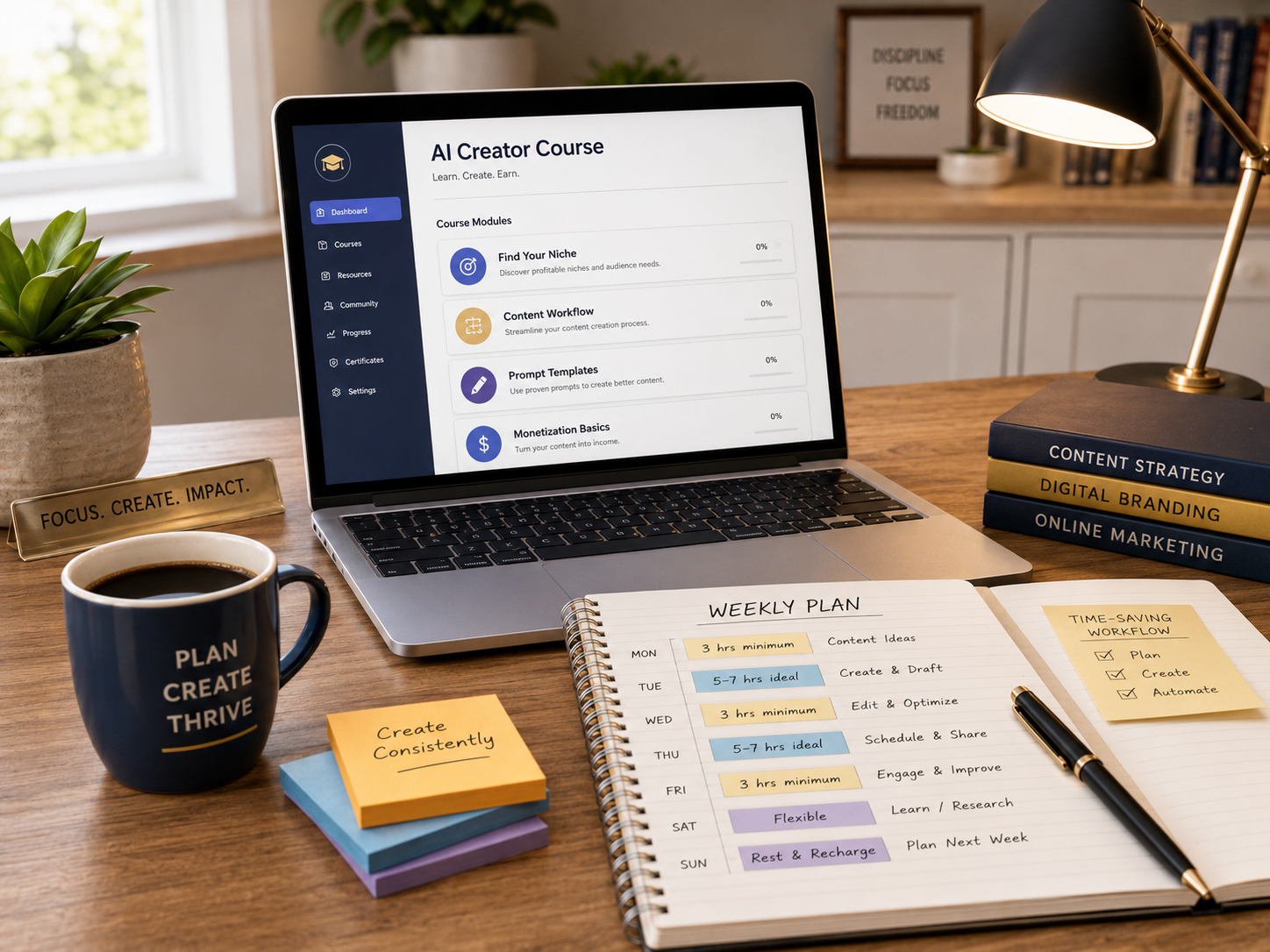
Most online courses promise to teach you how to “build a brand.” In real life, that usually means you watch a pile of videos and still sit there on Monday morning, wondering what you’re supposed to post. I’ve done that more times than I want to admit.
A good creator course should get to the point and answer three questions quickly. What should I make content about? How do I create it without burning out? And how does this actually turn into income? If a course can’t answer those, the rest is noise.
The AI Creator Course centres on a practical workflow, not vague theories. It uses AI tools to help you create and publish faster, especially when you're under a tight schedule.
From what these AI creator programs usually cover, the core pieces look like this. First, choosing a niche that can realistically support monetisation, not just likes. Then, using AI prompts to help write scripts, captions, and outlines so you’re not starting from a blank page every time.
There’s also a big emphasis on batching ideas, which matters when you can only work in short windows. On the money side, they walk through building simple offers like templates, small courses, or services, and connecting your content to leads and sales instead of hoping something goes viral.
The real benefit is not that AI does the work for you, but that it saves time by reducing blank-screen moments and unnecessary rewriting, enabling consistency.
I think this course works best for busy professionals who want to build a creator income stream without flipping their whole life upside down. You don’t need to quit your job or become a full-time YouTuber. The goal here is something that fits around work, family, and real responsibilities.
It’s ideal if you want a side income to expand your future career options. This supports those who struggle with consistency, have limited time, or prefer step-by-step plans over vague advice. If you prefer templates, prompts, and checklists, you’ll feel comfortable here.
On the flip side, it’s not a great match for everyone. If you already post consistently and have a clear niche, a lot of this will feel basic. If you expect results without publishing weekly, you’ll be disappointed. The same goes if you hate structured systems and prefer experimenting randomly.
Also, this course does not cover advanced growth tactics like funnels, ads, or scaling strategies. The curriculum is limited in terms of one-on-one support and won’t provide high-level growth schemes.
Here’s a simple gut check. If you’ve bought courses before and never finished them, the problem probably isn’t the curriculum. The course doesn’t offer accountability or behavioural change; it requires you to build a repeatable habit to make it work. If you struggle with follow-through, be realistic about your ability to implement. This course does not provide ongoing enforcement or personal coaching.
Most people plan to finish everything in one productive weekend. But then work gets busy, and weeks pass without posting. I’ve seen this cycle often.
If you’re working a regular 9–5, the time this takes really depends on what you’re trying to get out of it.
Bare minimum: about 3 hours per week
With about 3 hours a week, you can generate ideas, write two to three posts, and build the habit while learning how your audience responds.
Ideal pace: around 5 to 7 hours per week
Five to seven hours weekly lets you publish steadily, repurpose ideas, and gradually build a simple offer, often resulting in early leads or small sales.
Intensive pace: 8 to 10 or more hours per week
You don’t need 8 to 10 hours per week for results, but it helps accelerate growth or a launch. Think of this as optional, not the expectation.
If you’re a parent, micro-sessions are your best friend. Fifteen minutes during lunch, twenty minutes after the kids are asleep, and maybe a thirty-minute batch session on the weekend adds up quickly. In my experience, consistency almost always beats one massive Sunday grind that wipes you out for the week.
Free videos on AI tools and content creation abound. You can watch them for hours, as I have.
The problem is that free content usually feels like a buffet. You keep sampling everything, but you never sit down and make a real meal. You learn a lot of ideas, but nothing turns into a system you actually use.
Busy professionals don’t need more information. They need a process for tired, distracted, and time-limited moments.
A good course gives you a clear path, templates to speed up execution, examples to eliminate guesswork, and assignments that push you to act instead of just learn.
Free videos are still useful for exploring tools and picking up tips. I use YouTube for that myself.
Where they fall apart is helping you build a real content engine, stay consistent for eight to twelve weeks, or turn content into money. There’s no through line.
If the AI Creator Course gives you a repeatable framework you can follow week after week, it solves the biggest problem busy people face. You don’t have time to constantly research what to do next.
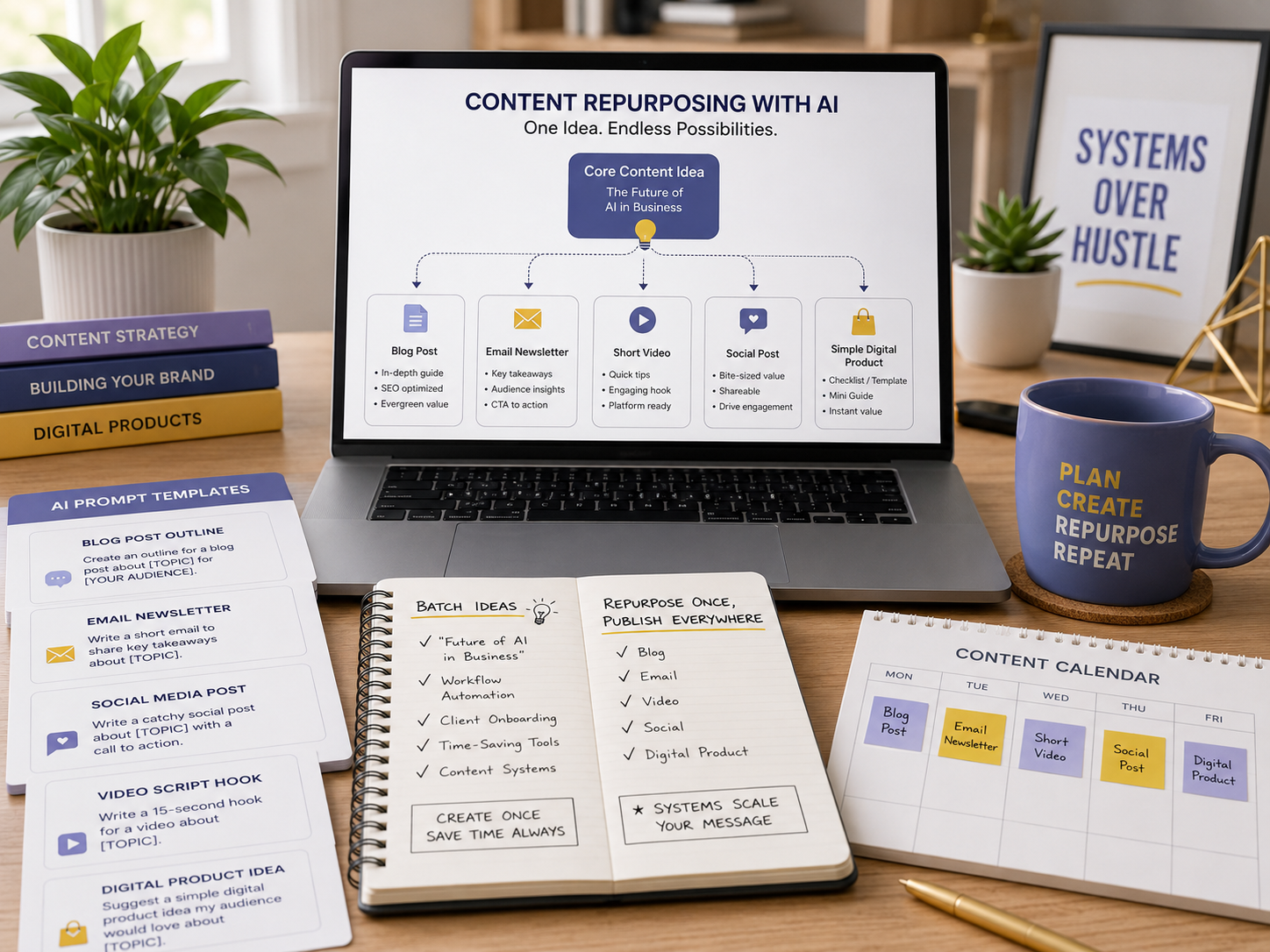
For a course like this to be worth the money, it has to reduce overwhelm fast. If you finish the first day still wondering what to do next, that’s a problem.
A truly beginner-friendly course should help you answer a few basic but important questions right away. What niche should I focus on in 2026? What do I post first? How do I use AI without everything sounding stiff or fake? What does a normal week actually look like? And how do I monetise without feeling awkward or salesy?
If the AI Creator Course walks you through a structured setup phase, that’s a very good sign. Things like choosing a niche, defining content pillars, brainstorming a simple offer, understanding your audience’s real pain points, and setting up a basic content calendar all matter more than fancy tactics.
Clarity beats motivation every time. After a long workday, you’re not suddenly going to feel inspired. You’re going to follow a checklist, or you’re going to scroll TikTok and tell yourself you’re “researching.” I’ve done both.
The real goal here is to remove decision fatigue so that creating content feels routine, not like a daily mental fight.
Let’s talk about money, because that’s usually what “worth it” really means.
Most beginners assume monetisation means ads, sponsorships, or going viral. That’s the long and slow path, especially if you’re starting from zero and don’t have time to chase algorithms.
For busy professionals, a faster, more realistic option is to build a simple offer and use content to support it. You’re not waiting to be discovered. You’re giving people a clear next step.
Common ways people do this include offering one-on-one services like editing, strategy help, content systems, or consulting. Others create digital products such as templates, prompt packs, or small toolkits. Some run mini-courses or live workshops. Affiliate marketing can also work if you’re already using and talking about specific tools.
If you’re consistent, here’s what realistic progress often looks like.
In months one and two, you’re publishing weekly, getting clearer on your message, and spending less time overthinking every post. It feels quieter, but the foundation is forming.
By months three and four, you may start getting inbound messages, small leads, or signals that people are paying attention. Nothing wild, but enough to confirm you’re on the right track.
Between months four and six, first sales are very possible, especially if your offer is simple and solves a clear problem.
Income varies widely, but many people can reasonably aim for their first hundred to five hundred dollars per month once they have consistency and a basic offer in place. With momentum and a repeatable system, five hundred to two thousand per month is realistic for some.
The people who win aren’t the most inspired. They’re the ones who treat this like a process they follow, not something they only do when the mood strikes.
AI is powerful, but it’s not magic. Used well, it saves time. Used poorly, it makes your content blend into the noise.
Where AI really shines in content creation is the unglamorous stuff. It’s great for outlining posts, turning messy thoughts into structured drafts, generating a few hook options, repurposing long pieces into short ones, and summarising ideas so they’re easier to explain. All of that cuts down the time between “I should post something” and actually hitting publish.
It goes wrong when people copy generic output and post it as is. Or when they write about things they’ve never actually done. That’s how you end up sounding like every other AI productivity creator online. In 2026, audiences can spot that instantly.
The goal isn’t to let AI write everything for you. The goal is simple. You bring the perspective and real experience. AI helps you move faster.
A solid workflow usually looks like this. You start with real life and real problems you’ve seen. Then you use AI to help structure and expand those ideas. After that, you edit so it sounds like an actual person, with specifics and opinions. Finally, you publish without chasing perfection.
That’s the difference between using AI as a tool and leaning on it as a crutch.
Here’s the uncomfortable truth. A lot of people buy courses in a moment of motivation, only for real life to get in the way.
Work gets busy. Kids get sick. Travel pops up. Energy drops. Suddenly, they’re behind, and quitting feels easier than catching up.
Most people don’t fail because the course is bad. They fail because they never built a system that fits their actual schedule.
If you want the AI Creator Course to work, you need a weekly rhythm that can survive a little chaos.
A simple “busy professional” setup might look like this. One short session to batch ideas, about thirty minutes. Another day to draft one or two pieces, maybe forty-five minutes. One session to edit and schedule, another forty-five minutes. And one quick repurposing session to turn that into short posts, about thirty minutes.
That’s roughly three hours total. It’s not heroic. It’s realistic.
The course only becomes worth it when it lives on your calendar, not on your someday list.
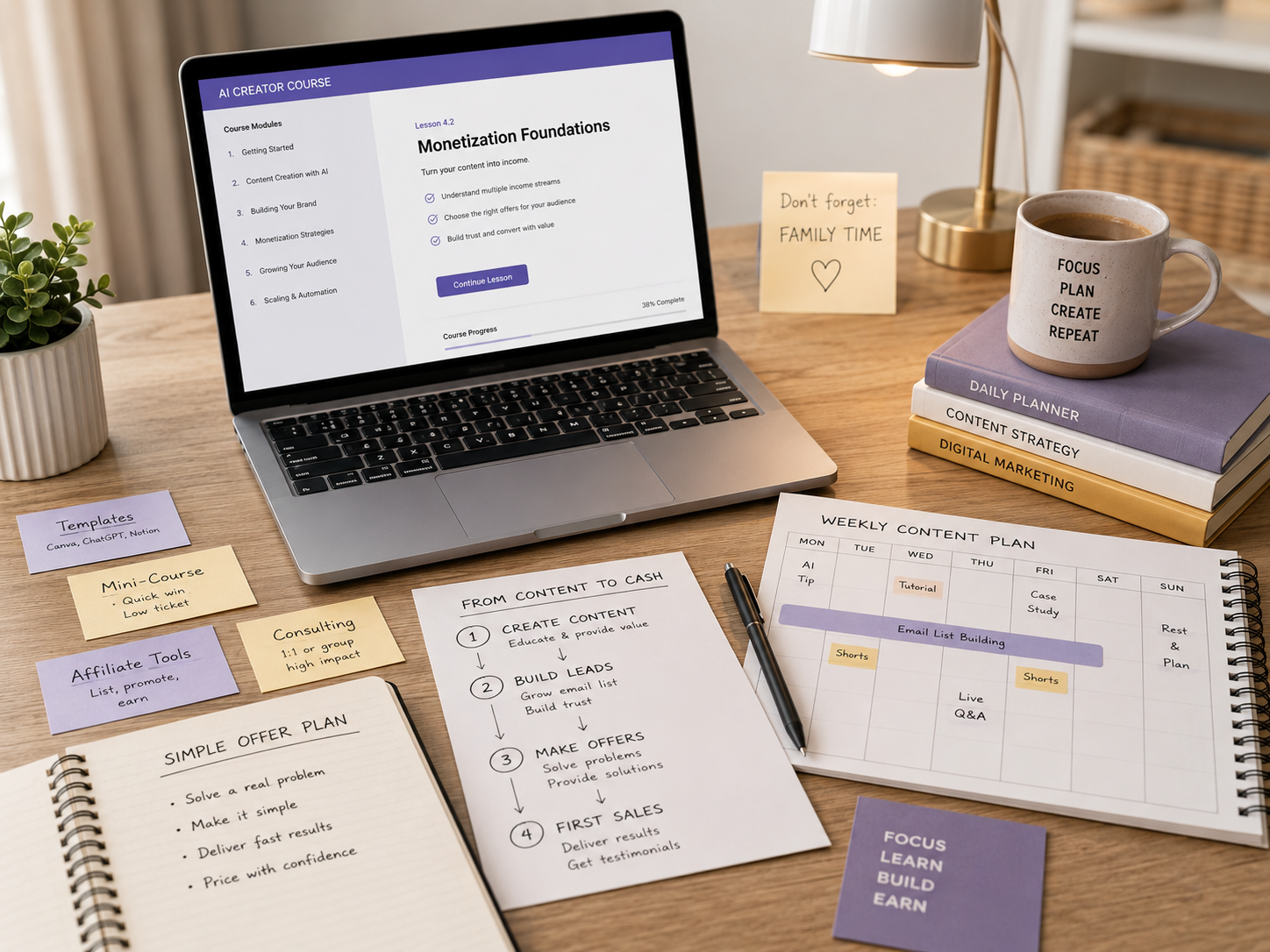
The biggest upside is speed. If you’ve ever spent an hour stuck on a caption or trying to outline a video after a long workday, AI can help you move forward without draining your brain. That alone matters when time is limited.
It’s especially useful if the course includes things like templates, plug-and-play prompts, and workflows you can repeat every week. Clear steps for monetisation also make a difference. For busy professionals, systems beat inspiration every time. If the course tells you what to do next instead of leaving you to guess, that’s what you’re really paying for.
On the downside, if the course leans too heavily on tool tutorials, it can feel thin. Tools change fast, and you can learn how to use them by watching YouTube tutorials for free.
It also won’t fix consistency problems on its own. You still have to show up and publish weekly, even when you’re tired or behind.
And if you expect AI to handle the creative thinking for you, you’ll probably end up with content that looks polished but doesn’t build much trust or lead to sales. AI can support the work, but it can’t replace your judgment or experience.
If you’re on the fence about the AI Creator Course, you’re not stuck. You’ve got a few solid options, and which one makes sense really depends on how you work.
This is the cheapest route, and it can work if you’re disciplined and patient. You piece things together from YouTube, newsletters, and podcasts, then hold yourself to a clear weekly plan. The tradeoff is time. Expect to spend five to ten hours a week, mostly sorting through advice and figuring out what applies to you. The biggest risk here is bouncing between ideas and never building real momentum.
Sometimes a smaller, focused program is better than a big all-in-one course. This works well if you already know your niche and just need help executing. The time commitment is usually 3 to 6 hours a week, and the cost is lower. You get less hand-holding, but more focus.
This is the fastest option if your time matters more than your budget. You’re paying for feedback, accountability, and someone telling you exactly what to fix. Time-wise, it can be as little as two to four hours a week, but the cost of money is high. This tends to work best for professionals who want speed and clarity without trial and error.
The right choice comes down to your biggest bottleneck. If you lack clarity, structure helps. If consistency is the issue, accountability matters. And if confidence is the blocker, feedback can make all the difference.
If you’re a busy professional with real career goals and limited time, and you want beginner-level clarity instead of more confusion,the AI Creator Course can be a smart buy in 2026.
I think it’s worth it if you want a clear, step-by-step system, prefer templates and checklists over guessing, can realistically commit at least three hours a week, and actually plan to publish consistently. Those pieces matter more than the course itself.
It’s probably not worth it if you’re hoping for quick results without doing the work, already have a strong content workflow in place, or are mostly interested in AI tool tutorials. That’s not what this is best at.
The biggest advantage is that it helps you stop overthinking and start shipping. That’s where real momentum comes from, and momentum is what eventually turns content into income.
If you want something that fits around a 9–5 and real life, and you’re ready to follow a process instead of winging it, this is one of the more realistic paths you can take.
Disclosure: I may receive affiliate compensation for some of the links below at no cost to you if you decide to purchase a paid plan. You can read our affiliate disclosure in our privacy policy. This site is not intending to provide financial advice. This is for entertainment only.


