

Hey busy dads, quick reality check. If you’ve been eyeing the TikTok + Reels Creator Course but keep thinking, “When am I supposed to do this?” you’re not alone. I felt the same.
We aren’t lacking motivation; we’re short on time. With work and family, paying for a course that becomes another bookmark isn’t appealing.
So let me be straight with you. This isn’t about adding another obligation to your packed schedule. Consider this: imagine you're at your kid's soccer practice, squeezing in those last few video edits on the sidelines while still being present in the moment.
It's about understanding the real weekly time commitment and whether it fits into your life, not some ideal where you find extra hours.
It’s about assessing the real weekly time commitment and seeing if it works for you.
I’ll walk you through how much time the course really takes, what you’re doing each week, and how I’ve seen it work for people with full plates.
Now, let’s break down exactly how the course fits into a packed schedule and what you can expect week by week.
Here’s the honest answer I wish more people would just say out loud. This course can take anywhere from 2 to 3 hours a week to 5 to 7. It really comes down to how fast you want to move and how much content you’re aiming to put out.

What I like is that it’s not an all-or-nothing situation. You don’t need a three-hour block on your calendar with perfect focus and no interruptions. That’s not real life. I’ve seen steady progress come from breaking it up into small chunks across the week.
Think for 20 minutes during a lunch break. Or 30 minutes once the kids are finally asleep and the house is quiet. That’s enough to keep the momentum going. You can build consistency without turning content creation into a second job or something that starts stealing time from the people who matter most.
Many courses claim they’re simple. Then suddenly, you’re ten hours in, taking notes like you’re back in school and wondering how it got so intense.
So here’s what the weekly work actually looks like.
Most weeks come down to three things. First, you learn the framework. This part is usually a short, focused lesson, not a marathon watch session. Second, you plan your content.
That’s just deciding what you’re going to post, not overthinking every word. Third, you create and post your videos.
That’s it. No expectation to live on your phone or check analytics constantly. Once you find your rhythm, it gets easier week after week. The hardest part is starting.
Honestly, watching the lessons is usually the easiest part. You’re not memorizing formulas or sitting through dry theory.
You’re learning how TikToks and Reels actually work, why certain videos make you stop scrolling, and how to keep your own content simple instead of overcomplicated.
Most of the lessons don’t feel like school. They feel more like, “Ohhh… that’s why that works.” Once the structure clicks, creating content becomes much lighter mentally.
You’re not second-guessing every idea or staring at a blank screen.
Time-wise, you’re looking at roughly 45 to 90 minutes a week. You can knock it out in one sitting if you’ve got the time, or split it into 10 or 15-minute chunks over a few days. Both work just fine, especially when life is already full.
People get stuck here. Planning sounds like it will take forever, but it doesn’t once you have a system.
Planning here is pretty simple. You’re choosing a few ideas, picking your hooks, and knowing what you want to say before you ever hit record.
A bit of prep makes filming easier. You’re not rambling, restarting, or wondering what your point is.
Most weeks, planning takes about 30 to 60 minutes. And once you start repeating formats that already work, that time can shrink to 15 minutes. That’s usually when things stop feeling heavy and start feeling doable.
This part really depends on you. Some people film quickly and do light edits. Others do many takes and redo everything. I’ve been on both sides, so no judgment.
Content creation takes 1 to 5 hours. Keep it simple to stay consistent without burnout.
The goal isn’t perfection. It’s repeatability. Something you can actually do again next week.
Most settle at 1 to 4 hours per week. Batching lowers that time. I’ll explain next.
If you want a realistic picture, here are the three schedules most people fall into. You can pick the one that fits your life right now and adjust later.
This is for the busy-parent season. The “I’m tired, but I still want progress” season.
The main takeaway: you can be consistent and make progress without feeling overwhelmed. This lighter schedule proves the course can realistically fit into even the busiest lives.
This is the sweet spot if you want growth without feeling overwhelmed.
Here, things feel smooth. You’re not scrambling. You’re building confidence and momentum.
This is for the season where you’re pushing. Maybe you want results faster, have a deadline, or want to stack content.
It’s more work, but it's worth it if you’re building hard for weeks. Don’t do this pace forever.
Batching is honestly what makes this doable for busy parents. Filming one video a day sounds easy, right up until real life shows up. Kids get sick.
Work runs late. You forget. You’re tired. Suddenly, you’re behind, stressed, and posting stops.
Batching gives you back a sense of control.
Instead of daily content stress, work in blocks. Plan, film, and let the week run more smoothly. Content becomes a brief task, not a chore.
This is the rhythm I like best:
Even batching three videos changes your week. Once they’re done, it’s a relief. You can focus on what matters.
If you’re a dad with limited time, this weekly rhythm works. It’s simple, repeatable, and not torture, that’s the point.
Here’s a realistic example:
Here’s the main takeaway: using small, repeatable steps let you keep showing up in manageable ways. That’s what makes long-term results sustainable.
A lot of people hear “content creation” and picture living on their phone. Constant posting. Chasing trends. Refreshing stats. That’s exhausting, and honestly, not realistic when you’ve got kids and a full life.
This course’s structure means you don’t need chaos. You aren’t guessing or reinventing every time.
You learn a few formats that actually work and tweak them each week. That’s how you build progress without frying your brain.
The goal isn’t to create content all day. It’s about creating content that fits into real life.
Most think time is the issue; it’s usually overthinking.
Overthinking turns ten minutes into an hour. “Quick video” becomes an ordeal. You restart, rewrite, refilm, and nothing gets posted.
It usually shows up like this:
Once you let go of perfect, everything moves faster. Content gets lighter. Filming feels less draining. Consistency becomes realistic.
One thing I want to be really clear about is that you don’t need to rush this.
A lot of people treat online courses like a race. They try to finish everything as fast as possible, then burn out, fall behind, and start feeling like they failed. That’s not failure. That’s just being human.
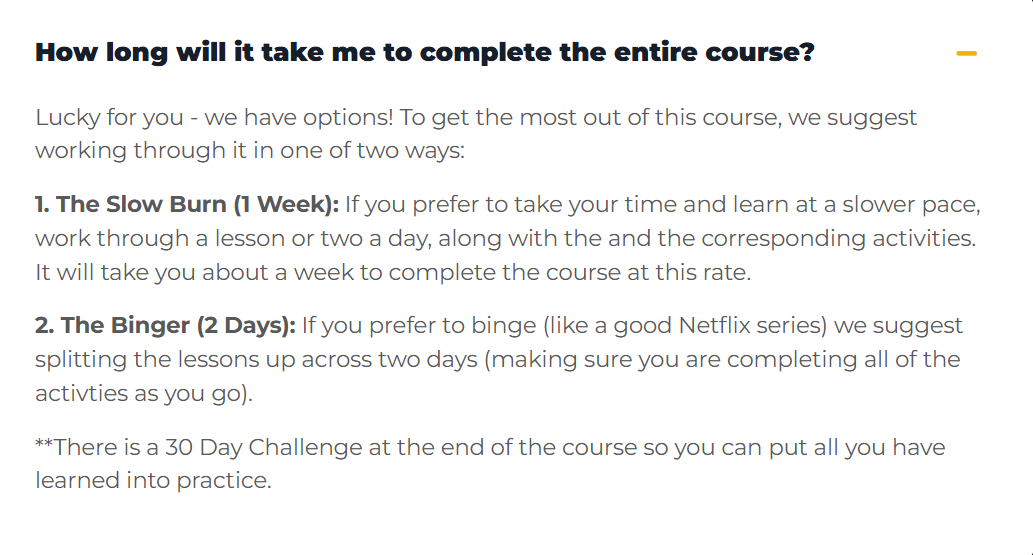
If life is full, move slowly and still win. Small weekly improvements add up. Huge jumps aren’t needed.
Consistency beats intensity every time, especially when you’re parenting and managing a real life that doesn’t pause just because you started a course.
This matters more than people realize, because your workload depends heavily on how many videos you’re trying to make.
If you’re just starting out, I usually recommend three videos per week. It’s enough to build consistency and confidence without wrecking your schedule.
And once you find your rhythm, batching three videos can fit into a pretty short session.
If three still feels like too much, even two a week is fine. What matters most is avoiding the all-or-nothing trap, where you post ten videos one week and then disappear for a month. Steady beats sporadically every time.
Some weeks are just chaos. Work explodes, the kids need extra attention, sleep is trash, and motivation disappears. That’s real life, not a discipline problem.
When that happens, don’t quit. Just downshift.
Here’s a minimum-effort plan that still keeps you moving:
That still counts as progress. More importantly, it keeps your routine alive. Slow weeks aren’t the problem. Stopping completely makes it hard to restart.
The first week usually feels like you’re just figuring things out. The second week is more like, “Okay, I can actually do this.” And then, almost without noticing, it stops feeling hard.
You think less.You film faster.You start recognizing what works and what doesn’t.
The biggest shift is confidence. You stop feeling like you’re just “trying content” to see what happens. You start feeling like you’re building something real. That mindset change is what helps people stick with it long term.
If you want the clean, no-nonsense answer, here it is.
Most people can handle this course in about three to five hours per week. That includes watching the lessons, planning, filming, and posting. And if you’re batching, it actually feels lighter because you’re not thinking about content every single day.
If you’re in a really busy season, you can still make it work in two to three hours a week. You’ll move slower, sure, but you’ll keep momentum. And when you’re a parent, momentum matters way more than speed.
If time is the main thing holding you back, here’s what I really want you to hear.
You don’t need more hours in your week.You need a plan that actually respects your life.
That’s what I appreciate about the TikTok + Reels Creator Course from OnePeak. It’s built in a way that can work even if you’re busy, even if you’re tired, and even if your only free time comes in small, awkward windows.
The approach that works best is pretty simple. Start small. Stay consistent. Batch when you can. And drop the pressure to do everything perfectly. Perfect is usually what makes people quit.
When you move at a pace you can actually maintain, that’s when results start showing up. Not overnight, but steadily. And steady progress is what fits real life.
If you’re tired of guessing and want a repeatable content routine that doesn’t take over your schedule, you can check out the TikTok + Reels Creator Course by OnePeak.
Done the smart way, it won’t run your life. It’ll fit into it.
Disclosure: I may receive affiliate compensation for some of the links below at no cost to you if you decide to purchase a paid plan. You can read our affiliate disclosure in our privacy policy. This site is not intending to provide financial advice. This is for entertainment only.


